Shanghai Masters: Complete Guide to the ATP Masters 1000 in China
The Rolex Shanghai Masters is one of the most important tournaments on the ATP Tour and the only ATP Masters 1000 event held in Asia.
Played on hard courts at the spectacular Qizhong Tennis Center, the tournament has become one of the defining events of the Asian swing. Since becoming a Masters 1000 in 2009, Shanghai has attracted some of the biggest names in men’s tennis, from Roger Federer and Andy Murray to Novak Djokovic, Daniil Medvedev and Jannik Sinner.
The tournament also has a remarkable connection with the history of professional tennis in the city. Shanghai previously hosted the ATP Finals, then known as the Tennis Masters Cup, before taking its place on the Masters 1000 calendar.
Here is everything you need to know about the Shanghai Masters.
Shanghai Masters at a Glance
- Official name: Rolex Shanghai Masters
- Location: Shanghai
- Venue: Qizhong Tennis Center
- Category: ATP Masters 1000
- Surface: Hard court
- Singles draw: 96 players
- Doubles draw: 32 teams
- First Masters 1000 edition: 2009
- Typical position in the calendar: October
The History of the Shanghai Masters
The current tournament dates back to 2009, when Shanghai became an ATP Masters 1000 event.
However, professional tennis had already established itself in the city more than a decade earlier. Shanghai hosted its first ATP Tour tournament in 1996, while the city later became the home of the Tennis Masters Cup in 2002 and again from 2005 through 2008.
The arrival of the ATP Masters 1000 tournament in 2009 followed the departure of the season-ending championships. The new event quickly established itself as one of the most important tournaments in Asia.
Shanghai made an immediate impression on the ATP Tour. From 2009 through 2013, the tournament was voted ATP Masters 1000 Tournament of the Year by the players in each of its first five editions.
The tournament was also an important part of the development of professional tennis in China, helping establish Shanghai as one of the sport’s major destinations in Asia.
The Qizhong Tennis Center
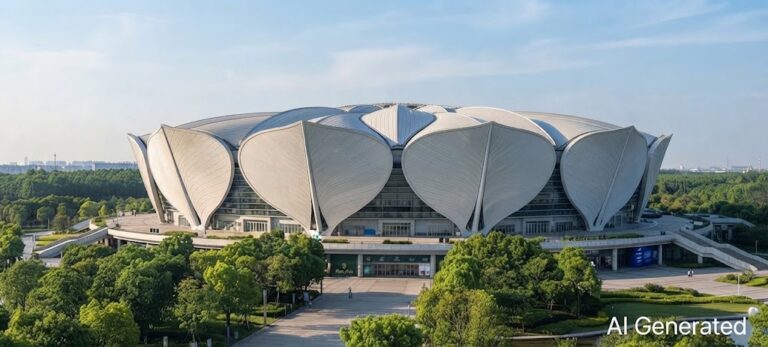
The Shanghai Masters is played at the Qizhong Tennis Center, located in the southwest of Shanghai.
The complex opened in 2005 and initially became famous for hosting the Tennis Masters Cup. Its centre court is particularly recognisable thanks to its distinctive retractable roof, designed in the shape of a magnolia flower, one of Shanghai’s most recognisable symbols.
The venue has continued to evolve alongside the tournament. Recent upgrades have further improved the facilities and spectator experience, reinforcing the Qizhong Tennis Center’s reputation as one of the major tennis venues on the ATP Tour.
The centre court is known as one of the most distinctive settings in men’s tennis, combining a large stadium atmosphere with the indoor-outdoor character created by its retractable roof.
When Is the Shanghai Masters Played?
The Shanghai Masters traditionally takes place in October, during the Asian swing that follows the US Open.
The tournament is normally preceded by ATP events in China and Japan before the Tour moves to Shanghai. After the Masters 1000, the ATP calendar continues with the European indoor season before reaching its climax at the Paris Masters and the Nitto ATP Finals. This position in the calendar makes Shanghai particularly important.
For the world’s best players, it is an opportunity to add another Masters 1000 title late in the season. For players fighting for qualification to the ATP Finals, the points available in Shanghai can be crucial.
The Tournament Format
Shanghai is one of the expanded Masters 1000 events. The singles draw contains 96 players, while the doubles draw features 32 teams. The event is played over 12 days, giving it a significantly larger footprint than many traditional ATP tournaments. As with other Masters 1000 events, the tournament is played in a knockout format.
Top seeds receive a bye into the second round, while the remaining players begin in the opening round. From there, players must win a succession of matches to reach the final.
The singles champion earns 1,000 ATP ranking points, making Shanghai one of the most valuable regular tournaments outside the four Grand Slams and the ATP Finals.
The Surface: Hard Court Tennis in Shanghai
Shanghai is played on outdoor hard courts. The surface makes the tournament part of the long hard-court stretch that dominates the ATP calendar from the North American summer through the end of the season.
Conditions in Shanghai can nevertheless make the tournament distinctive. Temperature and humidity can influence the speed of the court and the behaviour of the ball, particularly during the longer matches played in the Asian autumn.
That combination has produced a tournament where both aggressive baseline players and excellent defenders have enjoyed success.
The Greatest Champions in Shanghai
The list of Shanghai champions reads like a who’s who of modern men’s tennis.
Novak Djokovic: Novak Djokovic is the most successful singles player in tournament history, with four Shanghai titles. He won the tournament in 2012, 2013, 2015 and 2018, and also reached several other deep stages of the event. His first Shanghai title came in dramatic fashion in 2012, when he defeated Andy Murray in a final that went to a deciding-set tie-break. Djokovic’s dominance is also reflected in the tournament records: he has the most singles titles and the most match wins in Shanghai history.
Roger Federer: Federer won the Shanghai Masters twice. His first title came in 2014, when he defeated Gilles Simon in the final. He returned three years later to win the 2017 edition, defeating Rafael Nadal in the final. Federer’s second title also made him the oldest Shanghai champion, at 36 years old.
Andy Murray: Murray won the Shanghai Masters three times, in 2010, 2011 and 2016. His 2010 title made him the tournament’s youngest champion at the time, at 23 years old. Murray’s success was particularly notable during the period when Shanghai became one of the key events of the late-season calendar.
Daniil Medvedev: Medvedev captured his first Shanghai title in 2019.The Russian defeated Alexander Zverev in the final, completing a dominant tournament during one of the strongest stretches of his career.
Jannik Sinner: Sinner became the Shanghai champion in 2024, defeating Djokovic 7–6(4), 6–3 in the final. The victory was Sinner’s fourth Masters 1000 title and his seventh ATP Tour trophy of the 2024 season. It also ended Djokovic’s perfect record in Shanghai finals. Sinner’s victory continued a long Shanghai tradition of producing champions who are either current or former World No. 1s.
Valentin Vacherot: The Biggest Surprise, the 2025 edition produced one of the most extraordinary results in Masters 1000 history. Valentin Vacherot entered the tournament ranked No. 204 in the world and came through qualifying before winning the title. The Monegasque defeated, among others, Holger Rune and four-time champion Djokovic before beating his cousin Arthur Rinderknech 4–6, 6–3, 6–3 in the final. Vacherot became the lowest-ranked Masters 1000 champion in history, while also becoming the first player representing Monaco to win an ATP Tour singles title. The final itself was one of the most unusual in tournament history: Vacherot and Rinderknech had played college tennis together at Texas A&M University and are cousins.
Shanghai Masters Records
The tournament has produced several notable records.
| Record | Player | Achievement |
|---|---|---|
| Most singles titles | Novak Djokovic | 4 |
| Most singles match wins | Novak Djokovic | 43 |
| Most doubles titles | Marcelo Melo | 3 |
| Oldest champion | Roger Federer | 36 years old, 2017 |
| Youngest champion | Andy Murray / Jannik Sinner | 23 years old |
| Lowest-ranked champion | Valentin Vacherot | No. 204, 2025 |
| Lowest-ranked finalist | Valentin Vacherot | No. 204, 2025 |
The most recent tournament records list Vacherot’s 2025 triumph as the lowest-ranked title in Masters 1000 history, while Djokovic remains the record holder for both singles titles and match wins in Shanghai.
Shanghai and the Race to Turin
The Shanghai Masters has an important role in the final part of the ATP season. With the tournament taking place only weeks before the Paris Masters and the Nitto ATP Finals, the points won in Shanghai can significantly affect the Race to Turin.
The world’s top players are therefore competing for more than just another Masters 1000 trophy. Players on the qualification bubble can use a strong run in Shanghai to move closer to the season finale, while established contenders can strengthen their position among the world’s eight best performers of the season.
This makes Shanghai one of the key tournaments to follow during the final stages of the ATP calendar.
Why the Shanghai Masters Matters
Shanghai occupies a unique position in men’s tennis. It is the only ATP Masters 1000 tournament in Asia and the centrepiece of the Asian swing. Its modern history is relatively short compared with tournaments such as Monte Carlo, Cincinnati or Rome, yet its roll of honour already includes Djokovic, Federer, Murray, Medvedev and Sinner.
Its connection to the former Tennis Masters Cup also gives the tournament a deeper place in Shanghai’s tennis history than its 2009 Masters 1000 starting point might suggest.
And the 2025 edition demonstrated another defining characteristic of the event: even in one of the most prestigious tournaments on the ATP Tour, Shanghai can still produce an unexpected champion and an unforgettable story.
The Shanghai Masters in the ATP Season
The Shanghai Masters sits at the heart of the ATP’s autumn hard-court swing. After the US Open, players travel to Asia before returning to Europe for the final indoor tournaments of the season. Shanghai is therefore one of the last major opportunities to win a Masters 1000 title before the season finale.
For fans, it offers a different setting from the European and North American tournaments that dominate much of the ATP calendar. For players, it combines the prestige of a Masters 1000 with a crucial position in the race for the final rankings of the year. And for the ATP Tour itself, Shanghai represents the growth of men’s professional tennis in one of the world’s largest sporting markets.
From the historic Qizhong Tennis Center to a record four titles for Djokovic and the extraordinary 2025 triumph of Vacherot, the Rolex Shanghai Masters has already developed a distinctive identity of its own. With the world’s best players returning to China every autumn, Shanghai has firmly established itself as one of the defining tournaments of the modern ATP Tour.