Miami Open Guide: history, records and the final chapter of the Sunshine Double
The Miami Open is one of the most prestigious tournaments in professional tennis and a cornerstone of the ATP calendar.
Held every spring in Florida, the tournament represents the second half of the famous Sunshine Double alongside Indian Wells. While both events are ATP Masters 1000 tournaments, Miami has developed its own identity through faster conditions, a vibrant atmosphere and a long history of memorable champions.
For more than three decades, the Miami Open has attracted the world’s best players and produced some of the defining moments of the ATP Tour. Winning in Miami is often considered one of the most significant achievements outside the Grand Slams.

The history of the Miami Open
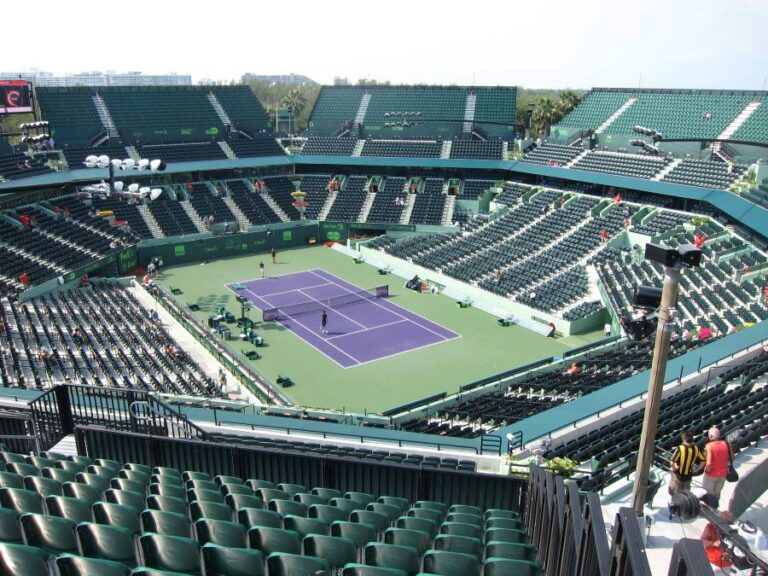
The tournament was founded in 1985 and quickly established itself as one of the most important events in tennis.
Originally known as the Lipton International Players Championships, the Miami Open was conceived as a tournament capable of rivaling the prestige of the Grand Slams. From the beginning, it attracted elite fields and became a key stop during the opening months of the season.
Over the years, Miami has crowned many of the sport’s greatest champions, from Andre Agassi and Pete Sampras to Roger Federer, Novak Djokovic and the stars of the modern era.
Today, it remains one of the flagship events of the ATP Tour and one of the most recognizable tournaments in world tennis.
Where is the Miami Open played?
Since 2019, the Miami Open has been held at Hard Rock Stadium in Miami Gardens, Florida.
The move from its former home at Key Biscayne marked a new chapter in tournament history. The modern venue offers one of the most impressive settings on the ATP Tour, combining world-class facilities with the energy and atmosphere associated with major American sporting events.
The stadium complex allows fans to experience tennis in a unique environment while maintaining the prestige that has defined the tournament for decades.
Surface and playing conditions
The Miami Open is played on outdoor hard courts.
Although it is often linked to Indian Wells because of the Sunshine Double, the playing conditions are noticeably different.
Miami generally features:
- Faster court speed;
- Higher humidity;
- More aggressive playing conditions;
- Greater emphasis on serving and first-strike tennis.
The Florida climate can also create challenging physical conditions, particularly during long matches played in heat and humidity.
As a result, Miami often rewards players capable of combining power, athleticism and adaptability.
The Sunshine Double
One of the reasons the Miami Open occupies such a special place in tennis history is its connection to the Sunshine Double.
The term refers to winning both Indian Wells Masters and Miami Open during the same season.
Because the two tournaments feature different conditions and are played back-to-back, completing the Sunshine Double is considered one of the most difficult achievements outside Grand Slam tennis.
Only a small group of players have managed to accomplish the feat:
- Jim Courier;
- Michael Chang;
- Pete Sampras;
- Marcelo Ríos;
- Andre Agassi;
- Roger Federer;
- Novak Djokovic;
- Jannik Sinner.
Djokovic holds the record with four Sunshine Doubles, while Sinner became the most recent player to complete the feat during the 2026 season.
The achievement is often viewed as an early indicator of dominance and has historically been associated with some of the greatest seasons in ATP history.
Tournament format and ranking importance
Like Indian Wells, the Miami Open uses an expanded Masters 1000 draw.
Men’s singles competition
- 96-player draw;
- 32 seeded players receive first-round byes;
- Seven rounds from the second round to the final;
- Best-of-three-set matches.
The tournament takes place over nearly two weeks and represents one of the most demanding stretches of the early ATP season.
ATP ranking points
As an ATP Masters 1000 event, Miami awards significant ranking points.
- Winner: 1,000 points
- Runner-up: 650 points;
- Semi-finals: 400 points;
- Quarter-finals: 200 points;
- Round of 16: 100 points;
- Round of 32: 50 points;
- Round of 64: 30 points;
- Round of 128: 10 points;
- Qualifiers: 20 points.
Strong performances in Miami often play a major role in shaping the ATP Rankings before the transition to the clay season.
Records and legendary champions
The Miami Open has been won by many of the greatest players in tennis history.
Most men’s singles records:
- Most titles: Andre Agassi and Novak Djokovic (6 titles);
Most finals appearances: Andre Agassi and Novak Djokovic (8 finals).
The Serbian and the American share the tournament record, a reflection of their dominance across different eras.
Other notable champions:
- Youngest champion: Carlos Alcaraz (2022, 18 years old);
- Oldest champion: Roger Federer (2019, 37 years old).
Few tournaments have consistently attracted such a high concentration of elite champions.
Miami Open and the ATP season
Positioned at the end of the hard-court spring, Miami often serves as a turning point in the ATP calendar.
The tournament concludes the Sunshine Double and provides the final major hard-court test before the transition to clay.
Historically, players who perform well in Miami frequently carry momentum into the European clay season, while disappointing results can lead to significant shifts in rankings and confidence.
For many contenders, Miami represents the first true assessment of their level after the Australian Open.
The tournament's place in modern tennis
While Indian Wells is often referred to as the “Fifth Grand Slam”, Miami has maintained equal importance within the ATP calendar.
Together, the two events form one of the most prestigious stretches of the season and consistently attract the strongest fields in tennis.
The combination of elite competition, American sporting culture and a long tradition of champions ensures that Miami remains one of the most important tournaments outside the four majors.
Why the Miami Open matters
Winning the Miami Open means more than collecting 1,000 ATP ranking points.
The tournament has historically been associated with the sport’s greatest champions and often provides the first major indication of who will shape the season ahead.
From Agassi and Sampras to Federer, Djokovic and the new generation of stars, Miami has repeatedly served as a stage where tennis history is written.
Conclusion
The Miami Open stands among the most prestigious tournaments in professional tennis.
Its role within the Sunshine Double, its history of legendary champions and its unique playing conditions have helped establish it as one of the ATP Tour’s defining events.
For players, winning in Miami is a statement of excellence. For fans, it remains one of the highlights of every tennis season and one of the most important stops on the road toward the rest of the year.