Roland Garros: history, clay court tradition and the ultimate test in tennis
Roland Garros, also known as the French Open, occupies a unique place in professional tennis.
As the second Grand Slam of the season and the only major played on clay, the tournament represents the sport’s ultimate examination of endurance, tactical intelligence and mental resilience. Every spring, the world’s best players arrive in Paris knowing that success at Roland Garros requires far more than talent alone.
The slower surface, physically demanding rallies and best-of-five-set format combine to create one of the toughest challenges in sport and one of its most prestigious titles.

History of Roland Garros
The French Open was first held in 1891, making it the oldest of the four Grand Slam tournaments. Initially restricted to French club members, the event gradually evolved into an international competition and eventually became one of the defining tournaments in tennis history.
A major turning point came in 1968, when Roland Garros became the first Grand Slam to open its draw to professional players, launching what is now known as the Open Era. Since then, the tournament has grown into a global sporting event while maintaining the traditions that continue to distinguish it from every other major.
Where is Roland Garros played
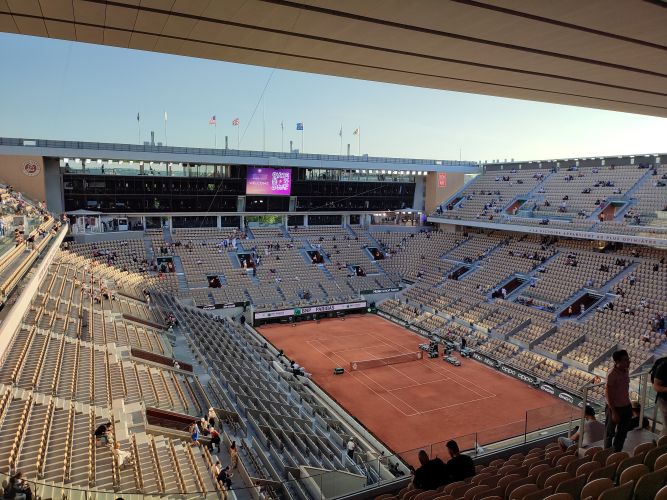
The tournament takes place at the Stade Roland Garros, located in the 16th arrondissement of Paris, France.
Over the decades, the venue has become one of the most iconic locations in tennis, blending historical atmosphere with modern infrastructure. Its main courts include:
- Court Philippe-Chatrier;
- Court Suzanne-Lenglen;
- Court Simonne-Mathieu.
Recent renovations have modernized the complex considerably, most notably with the addition of a retractable roof on Court Philippe-Chatrier, allowing play to continue during adverse weather conditions while preserving the tournament’s traditional identity.
Clay courts and why Roland Garros is different
What truly separates Roland Garros from the other Grand Slams is its surface.
Played on red clay, the French Open produces slower conditions, higher bounce and longer rallies than any other major tournament. The surface naturally reduces the effectiveness of pure power tennis and rewards players capable of constructing points patiently over extended exchanges.
Success on clay typically depends on:
- physical endurance;
- movement and defensive skills;
- tactical discipline;
- ability to generate topspin consistently.
Because of these conditions, Roland Garros is widely considered the most physically demanding tournament in tennis.
Tournament format and draw
Like the other Grand Slam tournaments, Roland Garros spans two weeks and includes multiple competitions across professional and junior categories.
Men’s singles format:
- 128-player main draw;
- Best-of-five sets;
- Seven rounds from the opening match to the final.
The tournament also includes:
- women’s singles;
- men’s and women’s doubles;
- mixed doubles;
- junior events;
- wheelchair competitions.
Matches on clay are often significantly longer than on other surfaces, particularly in the early rounds where physical endurance becomes a decisive factor..
Records and legendary champions
Roland Garros has produced some of the most dominant achievements in tennis history.
Most important men’s records (Open Era):
- Most titles: Rafael Nadal (14)
- Most consecutive titles: Rafael Nadal (5, from 2010 to 2014)
- Most finals appearances: Rafael Nadal (14)
Nadal’s dominance in Paris remains virtually unmatched in professional sport, earning him the nickname “King of Clay.”
Other legendary champions include:
- Björn Borg: 6 titles in 6 finals
- Novak Djokovic: 3 titles in 7 finals and multiple career Grand Slams completed in Paris
- Ivan Lendl and Mats Wilander: both 3-time champions in 4 finals
Each era has produced different styles of champions, but Roland Garros has consistently rewarded resilience and tactical intelligence above all else.

Why Roland Garros matters so much
Among the four Grand Slams, Roland Garros is often viewed as the tournament that most completely tests a player’s game.
Strong performances in Paris frequently:
- confirm clay-court dominance
- shape the ATP rankings significantly
- influence confidence heading into the second half of the season
Winning the French Open is considered one of the greatest accomplishments in tennis because of the unique demands imposed by the surface and format.
ATP ranking points at Roland Garros
As a Grand Slam tournament, Roland Garros awards the highest number of ATP ranking points available during the season:
- Winner: 2,000 points;
- Runner-up: 1,200 points;
- Semi-finals: 720 points;
- Quarter-finals: 360 points;
- Round of 16: 180 points;
- Round of 32: 90 points;
- Round of 64: 45 points;
- Round of 128: 10 points;
- Qualifiers: 25 points.
Because many clay-court specialists rely heavily on this period of the calendar, results at Roland Garros can dramatically affect the ATP Rankings and Race standings.
Roland Garros compared to the other Grand Slams
Each Grand Slam has its own identity, but Roland Garros stands apart because of the demands created by clay courts.
Compared to the other majors, the French Open is:
- slower than the Australian Open and US Open;
- more physically demanding than Wimbledon;
- less favorable to big servers and aggressive first-strike tennis.
This makes Roland Garros arguably the most tactically complex tournament in the sport.
The modern evolution of the French Open
In recent years, Roland Garros has modernized considerably while preserving its traditional atmosphere.
The introduction of night sessions, infrastructure upgrades and expanded global broadcasting has increased the tournament’s worldwide appeal, helping it evolve alongside the modern ATP Tour.
Despite these changes, the essence of Roland Garros remains unchanged: physical battles, tactical depth and relentless competition on clay.
Conclusion on Roland Garros
Roland Garros represents far more than a Grand Slam tournament.
It is the ultimate test of endurance, patience and adaptability in professional tennis, a tournament where every weakness is exposed over the course of two demanding weeks on clay.
Understanding the history, conditions and significance of the French Open helps explain why lifting the trophy in Paris remains one of the sport’s greatest achievements.