ATP Finals: complete guide to the season-ending championship
The ATP Finals represent the climax of the men’s professional tennis season. Played at the end of the year, this prestigious tournament brings together only the eight best singles players and doubles teams of the season, making it one of the most exclusive and competitive events on the ATP Tour.
Unlike Grand Slams, the ATP Finals feature a unique format, indoor conditions and a level of consistency rarely seen elsewhere. Winning the ATP Finals is often considered a hallmark of greatness and a defining achievement in a player’s career.

History of the ATP Finals
The ATP Finals were first held in 1970, originally known as the Masters Grand Prix. Over the decades, the tournament has evolved in name, format and location, reflecting the growth and globalization of professional tennis.
Some of the most iconic champions in tennis history have lifted the trophy, and the event has consistently showcased the very best players of each generation. In recent years, the ATP Finals have been held in Turin, Italy (from 2021 to 2030), following a long and successful period in London, England (from 2009 to 2020).
Despite the changes in venues, the tournament’s identity has remained the same: a battle among the elite to close the season at the highest possible level.
Where are the ATP Finals played?
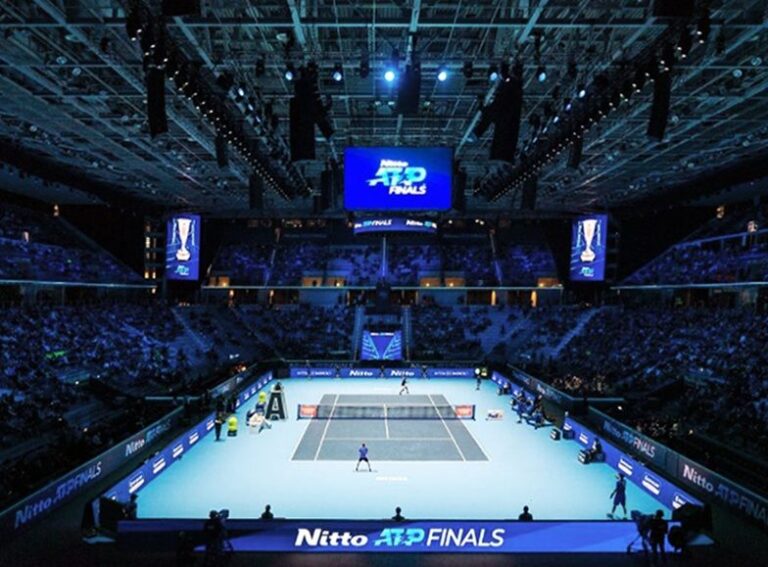
The ATP Finals are currently hosted in Turin, Italy, at the Pala Alpitour, a modern indoor arena specifically adapted for top-level tennis.
Key features of the venue include:
- – Indoor hard courts;
- – Controlled playing conditions;
– High seating capacity and modern facilities.
The indoor setting eliminates weather-related variables, ensuring consistent conditions throughout the tournament and placing a premium on precision, timing and tactical execution.
Playing surface and conditions
The ATP Finals are played on indoor hard courts, traditionally among the fastest surfaces on the tour.
Typical playing characteristics include:
- – Low and predictable bounce;
– Fast court speed;
– No wind or sun interference.
These conditions favor aggressive players, strong servers and those with excellent first-strike tennis. Shorter rallies and quick points are common, making every service game crucial.
Tournament format and draw
The ATP Finals feature a round-robin format, which sets them apart from all other major tournaments.
Singles competitions
- – 8 qualified players;
– Divided into two groups of four;
– Each player competes against the other three in their group.
The top two players from each group advance to the semifinals, followed by the final.
Matches are played best-of-three sets, with tiebreaks in all sets. This format rewards consistency and allows players a margin for error not found in traditional knockout tournaments.
Doubles competition
The doubles event follows the same group-stage format, featuring the eight best teams of the season.
Qualification criteria
Players qualify for the ATP Finals based on their results throughout the season.
Qualification is determined by:
- – Performance in Grand Slams;
- – Results in ATP Masters 1000 tournaments;
- – Titles and consistency across ATP events.
Only the top eight players in the ATP Race standings earn a place, making qualification itself a significant achievement.
Records and legendary champions
The ATP Finals have produced some of the most impressive records in men’s tennis.
Most singles records
- – Most titles: Novak Djokovic (7 ATP Finals titles in 9 finals);
– Most consecutive titles: Novak Djokovic (4 titles from 2012 to 2015);
– Most finals appearances: Roger Federer (6 ATP Finals titles in 10 finals).
Winning the ATP Finals multiple times is exceptionally difficult due to the strength of the field and the physical demands at the end of a long season.
Other notable champions
- – Ivan Lendl (5 ATP Finals titles in 8 finals);
– Pete Sampras (5 ATP Finals titles in 6 finals).


Why the ATP Finals matter so much
The ATP Finals hold a unique position in the tennis calendar.
They often:
- – Confirm the world’s best player of the season;
– Influence year-end rankings;
– Shape the narrative heading into the following year.
Because all participants are top-ranked, every match is high quality, and there are no “easy” opponents.
Impact on ATP rankings
The ATP Finals offer some of the highest ranking points outside the Grand Slams. An undefeated champion reach up to 1,500 points. Scores are divided as follow:
- – Match won in the round-robin: 200 points;
– Victory in semifinal: 400 points;
- – Victory in final: 500 points.
An undefeated run at the ATP Finals can significantly affect year-end rankings, including the battle for world No. 1.
ATP Finals vs Grand Slams
Compared to Grand Slams, the ATP Finals are:
- – Shorter in duration;
– Played exclusively indoors;
– Limited to elite players only.
While Grand Slams test endurance over two weeks and five-set matches, the ATP Finals test consistency, mental sharpness and adaptability against the very best opponents in rapid succession.
The ATP Finals in the modern era
In the modern era, the ATP Finals have become a highly polished, entertainment-driven event, combining elite sport with fan engagement and innovation.
Advanced analytics, night sessions and a compact schedule make the tournament appealing both to hardcore fans and casual viewers. Despite the spectacle, the competitive level remains extremely high, as players aim to finish the season on a defining high note.
Conclusion on the ATP Finals
The ATP Finals are much more than a season-ending tournament. They represent a final examination of a player’s ability to perform under pressure against the strongest possible field.
Understanding the format, conditions and significance of the ATP Finals helps explain why winning this event is considered one of the ultimate achievements in men’s professional tennis.