US Open: complete guide to the final Grand Slam of the season
The US Open is the fourth and final Grand Slam of the tennis season and one of the most dynamic tournaments on the ATP Tour. Played every summer in New York, it is known for its electric atmosphere, loud night sessions and physically demanding matches.
As the last major of the year, the US Open often delivers dramatic storylines and unpredictable outcomes, making it one of the most exciting events in professional tennis.
History of the US Open
The US Open was first held in 1881, making it one of the oldest tennis tournaments in the world. Originally known as the U.S. National Championships, the tournament evolved significantly over time, eventually becoming a key pillar of the modern Grand Slam circuit.
In 1968, the US Open became the first Grand Slam to adopt the Open Era format, allowing professional and amateur players to compete together. This decision marked a turning point in tennis history and solidified the tournament’s progressive identity.
Where is the US Open played?
The US Open takes place at the USTA Billie Jean King National Tennis Center, located in Queens, New York.
The venue includes several major courts, including:
- – Arthur Ashe Stadium;
- – Louis Armstrong Stadium;
– Grandstand.
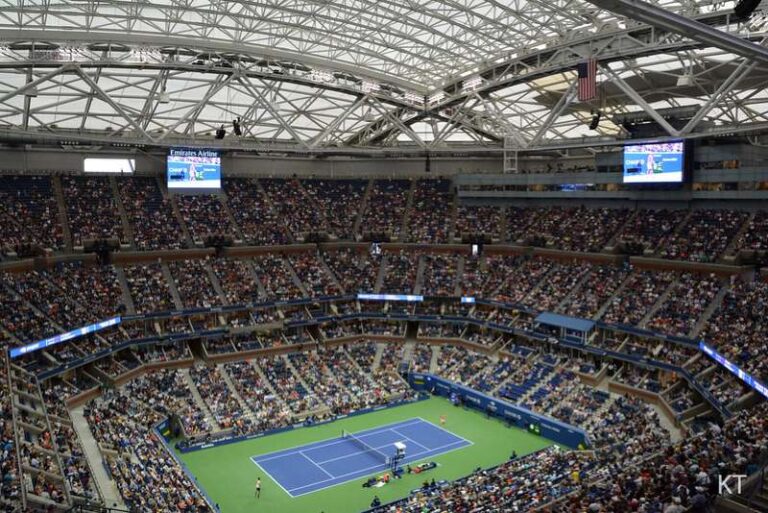
Arthur Ashe Stadium is the largest tennis stadium in the world (around 27,700 seats) and is famous for its intense night sessions and vibrant crowd atmosphere.
US Open surface and playing conditions
The US Open is played on hard courts, currently using the DecoTurf surface.
Key characteristics of the playing conditions include:
- – Medium-fast to fast court speed;
– Relatively low bounce compared to other hard-court events;
– High humidity and hot summer temperatures.
These conditions favor aggressive baseline players and strong servers, while physical endurance remains a critical factor, especially during long night matches.
Tournament format and draw
The US Open follows the traditional Grand Slam format over two weeks of competition.
Singles competitions
- – 128 players in the main draw;
– Best-of-five sets for men;
– Seven rounds, from the first round to the final.
Other events
- – Women’s singles (best-of-three sets);
– Men’s and women’s doubles;
– Mixed doubles;
– Junior and wheelchair events.
The US Open is often considered the most physically taxing Grand Slam due to heat, humidity and intense scheduling.
Records and legendary champions
The US Open has produced some of the most iconic champions in tennis history.
Most men’s singles records (after 1968)
- – Most titles: Jimmy Connors, Pete Sampras and Roger Federer (5 US Open titles and 7 finals each one);
– Most consecutive titles: Roger Federer (5 titles from 2004 to 2008);
– Most finals appearances: Novak Djokovic (10 US Open finals).
The tournament has consistently showcased dominant champions across different eras.
Other notable champions
- – John McEnroe (4 US Open titles in 5 finals);
- – Rafael Nadal (4 US Open titles in 5 finals);
– Novak Djokovic (4 US Open titles in 10 finals).
Each generation has contributed to the US Open’s reputation as one of the most competitive Grand Slam events.


Why the US Open matters so much
As the final Grand Slam of the season, the US Open holds a unique position in the tennis calendar.
Strong performances in New York often:
- – Define a player’s season;
– Influence year-end rankings;
– Determine qualification scenarios for the ATP Finals.
The pressure of closing the season adds an extra layer of intensity to every match.
How the US Open affects ATP rankings
As a Grand Slam tournament, the US Open awards the maximum number of ATP ranking points:
- – Winner: 2,000 points;
– Runner-up: 1,200 points;
– Semifinalist: 720 points.
Because it comes late in the season, ranking points earned at the US Open can be decisive for year-end standings.
US Open vs other Grand Slams
Compared to the other Grand Slam tournaments:
- – More unpredictable than Wimbledon and Roland Garros;
– More physically demanding than the Australian Open;
– More intense in atmosphere than any other Grand Slam.
Its urban setting and passionate crowds make the US Open a truly unique event.
The US Open in the modern era
The US Open has embraced innovation more than any other Grand Slam, from night sessions to advanced technology and fan engagement initiatives.
This modern, high-energy approach continues to define the tournament’s identity while preserving its historic importance.
Conclusion on the US Open
The US Open is more than just the final Grand Slam of the season. It is a tournament where pressure, physical endurance and mental strength reach their peak.
Understanding its history, surface and significance helps explain why winning the US Open is considered one of the most demanding achievements in professional tennis.