US Open: complete guide to the final Grand Slam of the season
The US Open is the fourth and final Grand Slam of the tennis season and one of the most distinctive tournaments in professional sport.
Played every summer in New York, the tournament combines more than a century of history with a uniquely modern atmosphere. From the enormous Arthur Ashe Stadium to the famous night sessions, the intensity of the New York crowd and the physical demands of late-summer hard-court tennis, the US Open offers an experience unlike any other Grand Slam.
It is also the tournament where the season reaches its climax. For some players, two weeks in New York can complete a remarkable year. For others, it can completely change the way a season is remembered.
With 2,000 ATP ranking points at stake and the ATP Finals race entering its decisive stages, the US Open remains one of the most important tournaments on the calendar.
History of the US Open
The US Open traces its origins back to 1881, when the U.S. National Championships were first held.
The tournament initially had a very different structure from the modern event and was contested on grass. Over the following decades, it evolved alongside American tennis, eventually becoming one of the four major championships of the sport.
The tournament became part of the Open Era in 1968, allowing amateur and professional players to compete against each other at the same event. This transformation marked a defining moment in tennis history and helped establish the modern Grand Slam structure.
The US Open has also changed surfaces several times throughout its history, moving from grass to clay before eventually adopting hard courts. That evolution is part of what makes the tournament particularly interesting: unlike Wimbledon or Roland Garros, its identity has been shaped by continual change.
Today, the US Open combines that history with one of the most modern presentations in professional tennis.
Where is the US Open played?
The US Open takes place at the USTA Billie Jean King National Tennis Center in Flushing Meadows, Queens, New York.
The complex is home to several iconic courts, including:
- Arthur Ashe Stadium;
- Louis Armstrong Stadium;
- Grandstand.
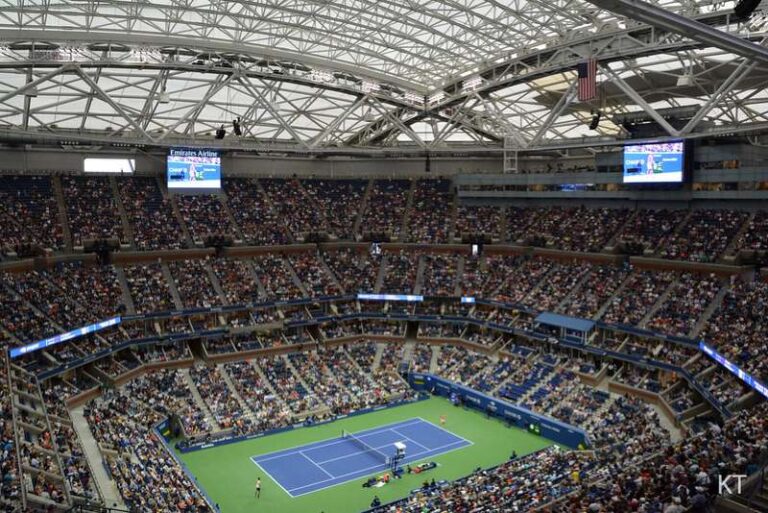
Arthur Ashe Stadium is the centrepiece of the tournament and one of the largest tennis stadiums in the world, with a capacity of more than 23,000 spectators.
Its retractable roof has also transformed the tournament’s ability to deal with rain, while allowing the famous night-session tradition to remain one of the defining features of the US Open.
The atmosphere inside Ashe Stadium is unlike anything else in tennis. Loud, passionate and occasionally unpredictable, the New York crowd can become a factor in its own right.
US Open surface and playing conditions
The US Open is played on outdoor hard courts, with the tournament currently using a Laykold surface.
Compared with the other Grand Slams, hard courts provide a relatively neutral environment. They do not give the extreme advantages associated with clay or grass, making the US Open one of the most complete tests of an all-court player’s game.
Conditions in New York can nevertheless be demanding. Late-August and early-September temperatures can be high, while humidity can make long matches physically exhausting. The combination of heat, five-set matches and potentially late finishes creates a particularly difficult physical challenge.
The surface generally rewards:
- Powerful and accurate serving;
- Aggressive baseline play;
- The ability to take the ball early;
- Strong return games;
- Physical endurance;
- Mental resilience in long matches.
The US Open therefore tends to favour players who can combine offensive firepower with the consistency required to survive two demanding weeks.
Tournament format and draw
The men’s singles tournament follows the traditional Grand Slam format.
The main draw contains 128 players, who compete across seven rounds:
- First round;
- Second round;
- Third round:
- Round of 16;
- Quarter-finals;
- Semi-finals;
- Final.
Men’s singles matches are played as best-of-five sets, meaning that a player must win three sets to advance.
The tournament also features:
- Women’s singles;
- Men’s doubles;
- Women’s doubles;
- Mixed doubles;
- Junior competitions;
- Wheelchair events;
- Qualifying tournaments.
The scale of the event is one of its defining characteristics. Every year, hundreds of players descend on Flushing Meadows hoping to make their mark on one of tennis’ biggest stages.
ATP ranking points at the US Open
As a Grand Slam tournament, the US Open awards the maximum number of ATP ranking points:
- Winner: 2,000 points;
- Runner-up: 1,200 points;
- Semi-finals: 720 points;
- Quarter-finals: 360 points;
- Round of 16: 180 points;
- Round of 32: 90 points;
- Round of 64: 45 points;
- Round of 128: 10 points;
- Qualifiers: 25 points.
Qualifying victories can also provide valuable ranking points.
Because the tournament comes so late in the season, a deep run in New York can have a major impact on the ATP Rankings and the Race to the ATP Finals. For players fighting to qualify for Turin, the US Open is often one of the last opportunities to make a significant move.
The US Open's greatest champions
Few tournaments have produced a more impressive collection of champions.
The men’s singles honour roll includes names such as Roger Federer, Pete Sampras, Jimmy Connors, John McEnroe, Rafael Nadal and Novak Djokovic.
In the Open Era, the record for most men’s singles titles is shared by three legends with 5 US Open titles in 7 finals each one:
- Jimmy Connors;
- Pete Sampras;
- Roger Federer.
Federer achieved his five titles through an extraordinary run of dominance, winning the tournament every year from 2004 through 2008. That five-year streak remains the record for consecutive men’s singles titles in the Open Era.
Novak Djokovic has won the tournament four times and holds an even more remarkable record: he has reached the US Open final 10 times, more than any other men’s player.
Rafael Nadal, meanwhile, won four titles in New York in 5 finals (as John McEnroe), completing his collection of US Open trophies across two different decades.
Each generation has contributed to the US Open’s reputation as one of the most competitive Grand Slam events.


The records that define the US Open
The tournament’s history is filled with statistics that illustrate its unique place in tennis.
Most men’s singles titles: 5, Jimmy Connors, Pete Sampras and Roger Federer.
All three achieved the record during the Open Era.
Most consecutive men’s singles titles: 5, Roger Federer.
Federer won five consecutive championships from 2004 to 2008, one of the most dominant stretches in modern Grand Slam history.
Most men’s singles finals: 10, Novak Djokovic.
Djokovic’s 10 appearances in the US Open final (with 4 titles) underline his extraordinary consistency at Flushing Meadows.
Most men’s singles matches played: 115, Jimmy Connors.
Connors remains the men’s record holder for singles matches played at the US Open, ahead of Djokovic and Federer.
Youngest men’s champion in the Open Era: Pete Sampras at 19 years and 28 days
Sampras won the 1990 US Open at just 19 years old.
Carlos Alcaraz is second on the Open Era list. He won the 2022 tournament at 19 years, four months and five days.
These numbers demonstrate how difficult it is to achieve sustained success in New York. Winning once is an extraordinary accomplishment; returning year after year and reaching the latter stages is something only the greatest players have managed.
The US Open and the greatest rivalries
The tournament has played a central role in some of tennis’ most important rivalries.
The Federer-Sampras generation gave way to the battles between Federer, Nadal and Djokovic, while the emergence of Carlos Alcaraz and Jannik Sinner has created a new era of competition at the top of men’s tennis.
The US Open has repeatedly been the stage where these rivalries have produced some of their defining chapters. Recent finals illustrate just how quickly tennis can change.
In 2022, Alcaraz won his first Grand Slam title in New York and became the youngest men’s world No. 1 in ATP history. Daniil Medvedev defeated Djokovic in the 2021 final, preventing the Serbian from completing a calendar-year Grand Slam. In 2023, Djokovic returned to the top by winning his fourth US Open title. In 2024, Sinner captured his first US Open crown, defeating Taylor Fritz in the final. And in 2025, Alcaraz reclaimed the trophy by defeating Sinner in the final.
That sequence perfectly captures the tournament’s modern identity: established champions, new generations and changing rivalries constantly colliding in New York.
Why the US Open is so important
The US Open is more than simply the final Grand Slam of the season. Its position on the calendar gives the tournament an importance that the other majors do not quite share.
By the time players arrive in New York, they have already completed three Grand Slams, the majority of the Masters 1000 season and months of competition.
For some, the US Open represents the final chance to rescue a disappointing season. For others, it is the opportunity to complete a year of dominance with another major title.
The tournament can also determine the final stages of the ATP Finals race, making the two weeks in New York particularly important for players outside the very top of the rankings.
The US Open and the North American hard-court swing
The tournament is the culmination of the North American hard-court season. The Canadian Open and Cincinnati Masters provide two of the most important preparation events in the weeks leading up to New York, while ATP 500 and ATP 250 tournaments give players further opportunities to build momentum.
This sequence creates a natural narrative throughout the summer. Players who perform well in Canada and Cincinnati often arrive at the US Open with confidence and match rhythm. Others may use those tournaments to make technical adjustments before the year’s final major.
By the time the US Open begins, there is very little room left for experimentation. The best players need to be ready immediately.
US Open vs the other Grand Slams
Every Grand Slam has its own identity.
Australian Open: Played at the beginning of the season, Melbourne combines fast hard courts with intense summer conditions and often represents the first major test of a player’s new season.
Roland Garros: The only Grand Slam played on clay, Paris rewards endurance, patience and tactical construction. Rafael Nadal’s 14 titles have made it the most dominant individual story in Grand Slam history.
Wimbledon: The most traditional Grand Slam, Wimbledon is defined by grass, history and a unique set of tactical demands.
US Open: New York is different. Its hard courts, night sessions, enormous crowds and late-season pressure create an atmosphere that is arguably the most intense of the four majors. The tournament is also historically associated with innovation and spectacle, making it the most overtly modern Grand Slam.
The US Open in the modern era
The tournament has embraced modern technology and entertainment without abandoning its historical identity. The retractable roof at Arthur Ashe Stadium, night sessions, electronic line calling and increasingly sophisticated fan experiences have transformed the event into a global sporting spectacle.
At the same time, the fundamental challenge remains unchanged. Players still have to win seven best-of-five-set matches to lift the trophy. That is what makes the US Open so difficult.
No matter how modern the tournament becomes, the champion still has to survive two weeks of elite-level tennis under extraordinary physical and psychological pressure.
Why the US Open is one of tennis' ultimate challenges
Winning a Grand Slam is never easy. Winning the US Open requires a particularly broad combination of qualities.
A champion needs the physical strength to deal with the heat and humidity, the technical ability to compete on hard courts, the mental resilience to survive five-set battles and the consistency to perform across seven rounds.
There is also the unique pressure of New York. The crowds are enormous, the attention is global and the biggest matches are often played under the lights. That combination explains why some players thrive at Flushing Meadows while others struggle to reproduce their best tennis there.
The US Open rewards complete competitors.
Conclusion
The US Open is more than the final Grand Slam of the tennis season. It is one of the sport’s great historical institutions, a tournament defined by legendary champions, extraordinary records and an atmosphere unlike any other major. From its origins in 1881 to the modern spectacle of Arthur Ashe Stadium, the tournament has continually evolved while maintaining its place at the heart of professional tennis.
Its records tell the story: five-time champions such as Connors, Sampras and Federer, Djokovic’s record 10 finals, Federer’s five consecutive titles and the emergence of young champions such as Sampras and Alcaraz. But perhaps the most important characteristic of the US Open is its unpredictability.
Every year, New York provides a new story. And when the final ball is struck under the lights in Arthur Ashe Stadium, one player leaves Flushing Meadows with something that can never be taken away: a place in US Open history.