Monte Carlo Masters preview: Sinner’s momentum, Alcaraz’s defense and a wide-open clay season
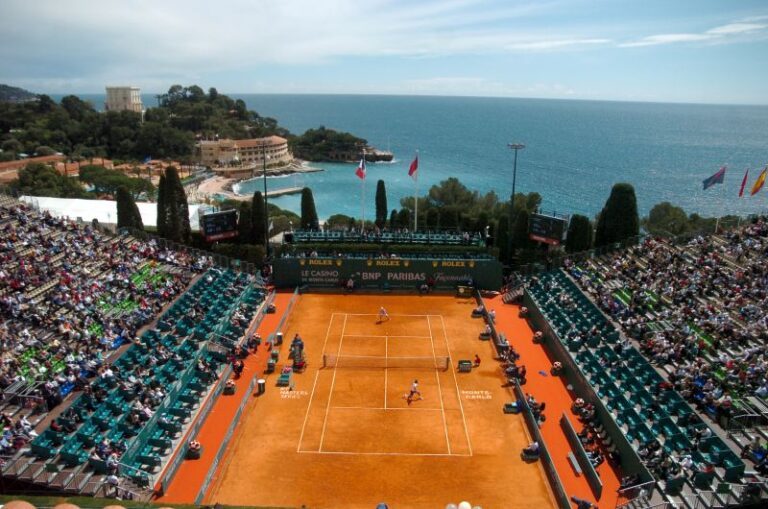
The ATP Tour shifts from hard courts to clay with one of its most iconic stops: the Monte Carlo Masters. Set against the backdrop of the Mediterranean, the tournament traditionally marks the beginning of the European clay swing — but this year, it arrives with a particularly compelling narrative.
Jannik Sinner enters Monaco after completing a historic Sunshine Double, while Carlos Alcaraz returns as defending champion under increasing pressure. With key absences and shifting form across the tour, Monte Carlo opens the clay season with uncertainty and opportunity.

Sinner arrives as the man to beat
Jannik Sinner’s form heading into Monte Carlo is impossible to ignore. The Italian arrives after winning Indian Wells and Miami without dropping a set, extending a remarkable streak of dominance at Masters 1000 level.
Beyond the results, it is the manner of his performances that stands out: controlled aggression, improved serve efficiency, and an ability to dictate rallies against any opponent.
Yet clay presents a different challenge. While Sinner has developed into a complete player, Monte Carlo will test his adaptability, movement, patience, and point construction become more decisive on this surface.
Still, given his current level and confidence, he enters as arguably the most in-form player on tour, and a leading contender for the title. At the start of the tournament, Sinner will be only 190 points behind Alcaraz. Winning the tournament, as well as gaining at least 190 points more than the Spaniard, would guarantee the Italian’s return to world number one in the ATP rankings.
Alcaraz and the pressure of defending
Carlos Alcaraz arrives in Monte Carlo with a different narrative. The Spanish is the defending champion, but his recent performances have been less convincing compared to his early-season peak.
Clay, however, remains his natural habitat. His ability to generate heavy topspin, vary pace, and dominate physically makes him one of the most complete players on the surface.
The key question is not whether Alcaraz can perform on clay, but whether he can immediately rediscover his best level after a mixed hard-court swing.
With the added pressure of defending ranking points and the possibility of losing the world No.1 ranking to Sinner, his campaign in Monte Carlo carries significant weight.
A draw shaped by absences
This year’s tournament is notably impacted by key withdrawals.
Novak Djokovic will not compete in Monte Carlo due to injury, removing one of the most experienced clay-court competitors from the field.
His absence contributes to a more open draw, increasing opportunities for players just outside the very top tier to make a deep run. It also shifts the balance at the top, reinforcing the current dynamic centered around Sinner and Alcaraz.
The contenders: depth and unpredictability
Beyond the two leading names, the field remains deep and dangerous.
Alexander Zverev enters as a consistent presence at Masters 1000 level, capable of going deep on any surface. Daniil Medvedev, while less naturally suited to clay, has shown adaptability in recent seasons. Lorenzo Musetti will start the tournament as the fourth seed and a finalist in 2025.
Players like Casper Ruud and Andrey Rublev bring strong clay credentials, while emerging names — including Jiří Lehečka and Learner Tien — arrive with confidence after strong performances in recent tournaments.
Monte Carlo, traditionally less predictable than other Masters events, often rewards players who quickly adapt to conditions and build momentum early in the week.
What to expect from the first clay test
Monte Carlo rarely provides definitive answers, but it offers strong indications.
The transition from hard courts to clay is one of the most demanding shifts in tennis. Movement patterns change, rallies extend, and tactical patience becomes essential.
For some players, the adjustment is immediate. For others, it takes time. As a result, early rounds often produce surprises, while the latter stages tend to reward those who have fully adapted to the surface.
Conclusion
Monte Carlo opens the clay season with a clear storyline and an uncertain outcome.
Sinner arrives with momentum and confidence, Alcaraz with pedigree and pressure. Around them, a deep field looks ready to challenge, in a tournament where conditions and timing often matter as much as ranking.
As the road to Roland Garros begins, Monte Carlo is not just the first step — it is the first real test.