Monte Carlo recap: Sinner defeats Alcaraz to claim first clay title and reclaim world No.1
The Monte Carlo Masters opened the European clay season with a defining statement at the top of the game.
Jannik Sinner, already the dominant force of the early season, carried his momentum onto clay, defeating Carlos Alcaraz in the final to secure his first title in Monaco (and first Masters 1000 or ATP500 title on clay) and reclaim the world No.1 ranking.
In a tournament shaped by emerging stories and shifting dynamics, Monte Carlo ultimately revolved around a rivalry that continues to define the ATP Tour.
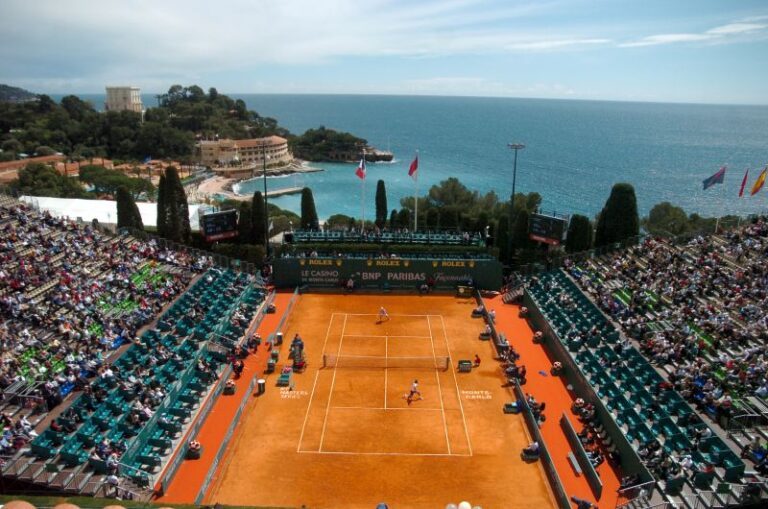

Sinner’s form carries onto clay
Jannik Sinner’s victory in Monte Carlo was not an isolated success, it was the continuation of a remarkable stretch that has positioned him as the player to beat in 2026.
Arriving after completing the Sunshine Double, the Italian extended his winning streak and showed that his evolution is no longer surface-dependent. What stood out throughout the week was not only his baseline dominance, but his growing maturity on clay: longer rallies, improved shot selection, and a willingness to construct points rather than rush them.
Physically, Sinner appeared sharper and more resilient than in previous seasons, managing demanding exchanges without a drop in intensity. Mentally, he maintained a level of composure that allowed him to control key moments; particularly against higher-ranked opponents.
In the final against Alcaraz, Sinner absorbed pressure early before progressively taking control of the match, dictating from the baseline and limiting the Spaniard’s ability to impose his rhythm.
The win not only delivers his first Monte Carlo title, but also marks another Masters 1000 triumph (the first one on clay) in what is becoming a defining season. Crucially, it sees him reclaim the world No.1 ranking, overtaking Alcaraz and reinforcing his position at the top of the ATP hierarchy.
Alcaraz falls short but remains a central force
For Carlos Alcaraz, the final represented both a missed opportunity and a reminder of his enduring competitiveness.
The Spaniard showed flashes of his best tennis throughout the tournament, particularly in his ability to accelerate rallies and dominate physically on clay. However, against Sinner, he struggled to sustain that level over the course of the match.
There were moments where Alcaraz imposed his aggressive patterns, but inconsistency at key stages and a slight dip in execution proved decisive.
Despite the loss (and the surrender of the No.1 ranking) his performance in Monte Carlo confirms that he remains one of the most dangerous players on clay. The margins at the top, however, are becoming increasingly fine.
A rivalry defining the new era
The final in Monte Carlo added another chapter to what is rapidly becoming the defining rivalry of the current ATP era.
Sinner and Alcaraz represent contrasting styles (controlled precision versus explosive creativity) but their encounters consistently produce high-level, tactical battles.
More importantly, their rivalry is now directly tied to the top of the rankings. With each meeting carrying implications not only for titles but also for the No.1 position, their dynamic is shaping the narrative of the tour.
Monte Carlo confirmed that the balance between the two remains fluid, but for now, Sinner holds the edge.
Finalists and a tournament of contrasting stories
Beyond the final, Monte Carlo offered a range of narratives that highlighted both depth and unpredictability on tour.
Among the standout stories was Valentin Vacherot, whose run to the semifinals captured the attention of the home crowd. Representing Monaco, the 27-year-old (who until recently was outside the top tier of the rankings) produced the best tennis of his career.
Vacherot combined aggressive shot-making with composure under pressure, defeating higher-ranked opponents and demonstrating a level that suggests he could establish himself more consistently on clay. His run was not just a surprise, but one of the defining stories of the week.
Zverev solid, Musetti falls short
Alexander Zverev once again showed his reliability at Masters 1000 level, progressing deep into the draw with structured, efficient tennis. His consistency from the baseline and improved physical condition allowed him to remain competitive against the top players, even if he ultimately fell short of the final, especially against Sinner and Alcaraz.
In contrast, Lorenzo Musetti experienced a disappointing campaign. On a surface that should enhance his natural variation and creativity, the Italian struggled to find rhythm and continuity. His early exit against Vacherot in round of 16 highlighted the ongoing challenge of translating potential into consistent results at the highest level.
What Monte Carlo tells us about the clay season
Alexander Zverev once again showed his reliability at Masters 1000 level, progressing deep into the draw with structured, efficient tennis. His consistency from the baseline and improved physical condition allowed him to remain competitive against the top players, even if he ultimately fell short of the final, especially against Sinner and Alcaraz.
In contrast, Lorenzo Musetti experienced a disappointing campaign. On a surface that should enhance his natural variation and creativity, the Italian struggled to find rhythm and continuity. His early exit against Vacherot in round of 16 highlighted the ongoing challenge of translating potential into consistent results at the highest level.
Conclusion
Monte Carlo delivered a clear message at the start of the clay season.
Jannik Sinner is not only the most in-form player on the tour, he is now the benchmark across surfaces.
With Alcaraz close behind and a deep field ready to challenge, the road to Roland Garros promises to be defined by fine margins, evolving rivalries, and a level of competition that continues to rise.