Italian Open: history, clay court tradition and the road to Roland Garros
Few tournaments on the ATP Tour carry the same weight and tradition as the Italian Open (named also “Internazionali d’Italia”). Played in the heart of Rome at the historic Foro Italico, this Masters 1000 event represents the final and most significant test before Roland Garros.
Blending history, atmosphere, and elite competition, Rome offers one of the purest expressions of clay-court tennis, where physical endurance, tactical intelligence, and experience often determine success.
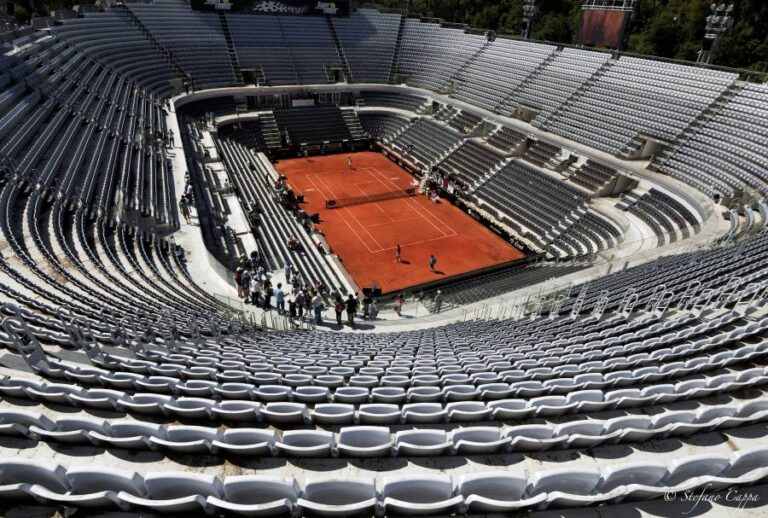

A historic tournament at the heart of European clay
The Italian Open was first held in 1930, initially in Milan, before moving to Rome in 1935, where it found its permanent home at the Foro Italico.
Over the decades, the tournament has evolved into one of the most prestigious events on the tennis calendar, becoming part of the ATP Masters 1000 series in 1990 and consistently attracting the world’s best players.
Today, it stands as one of the defining clay-court tournaments, combining tradition with a unique atmosphere created by its iconic venue and passionate crowds.
The Foro Italico: one of tennis’ most iconic venues
The Foro Italico is more than just a tennis complex, it is one of the most recognizable settings in the sport. Surrounded by classical statues and Mediterranean architecture, it creates a distinctive visual identity unmatched on the ATP Tour.
The main stadium, Stadio Centrale, holds over 10,000 spectators, while courts like Pietrangeli are widely regarded as among the most beautiful in the world.
This combination of history and atmosphere makes Rome not just a tournament, but an experience for both players and fans.
Pure clay conditions and playing style
Unlike Madrid, Rome offers traditional clay conditions.
The surface is slower, rallies are longer, and matches often become physical battles of endurance. Players must rely on:
- consistency from the baseline;
- patience in constructing points;
- physical and mental resilience.
These conditions make Rome one of the most reliable indicators of form ahead of Roland Garros, often favoring true clay-court specialists.
Tournament format and ranking importance
The Italian Open follows the ATP Masters 1000 format, with a 96-player singles draw and seeded players receiving a first-round bye.
The winner earns 1000 ranking points, making the tournament a crucial step in the ATP Rankings and the Race to the ATP Finals.
Ranking points are crucial:
- Winner: 1,000 points;
- Runner-up: 650 points;
- Semi-finals: 400 points;
- Quarter-finals: 200 points;
- Round of 16: 100 points;
- Round of 32: 50 points;
- Round of 64: 30 points;
- Round of 128: 10 points;
- Qualifiers: 20 points.
Since 2023, the event has expanded into a longer format, aligning with other major Masters tournaments and increasing its overall significance in the calendar.
Records, champions and clay legends
Rome has been defined by some of the greatest clay-court players in history. Rafael Nadal holds the record with 10 titles, confirming his dominance on clay, and Novak Djokovic has also enjoyed success, winning multiple titles and reaching numerous finals.
More recently, the tournament has crowned a variety of champions, reflecting the increasing competitiveness of the ATP Tour.
Most men’s singles records (after 1968):
- Most titles: Rafael Nadal (10 titles);
- Most consecutive titles: Rafael Nadal (3 titles from 2005 to 2007);
Most finals appearances: Rafael Nadal and Novak Djokovic (12 finals).
Other notable champions (after 1968):
- Novak Djokovic (6 titles in 12 finals);
- Thomas Muster (3 titles in 3 finals);
- Ilie Năstase and Alexander Zverev (2 titles in 3 finals).
Despite this variety, Rome has consistently rewarded players with strong clay fundamentals and tactical discipline.
Why Rome matters before Roland Garros
Positioned just before Roland Garros, the Italian Open is widely considered the final and most important preparation event of the clay season.
Unlike Monte Carlo, where players are still adapting, and Madrid, where conditions are unique, Rome provides the closest approximation to the conditions in Paris.
For this reason, performances in Rome often serve as a strong indicator of potential success at Roland Garros — both in terms of form and physical readiness.
What defines success in Rome
Winning in Rome requires a specific set of qualities:
- elite physical endurance;
- tactical patience and consistency;
- ability to handle long rallies;
- mental strength in key moments.
Players who excel in these areas are typically those who contend not only in Rome, but also in the later stages of Roland Garros.
Conclusion
The Italian Open stands as one of the most important and prestigious tournaments on the ATP Tour.
With its rich history, unique setting, and demanding clay conditions, it represents both a celebration of tennis tradition and a decisive step in the road to Roland Garros.
In Rome, more than anywhere else in the clay season, the balance between talent, endurance, and experience determines who is ready for the sport’s biggest stage.