Madrid Open: history, altitude, and the unique challenge of clay tennis
Few tournaments on the ATP Tour offer conditions as distinctive as the Madrid Open. Played on clay but at high altitude, the event blends elements of both clay and faster surfaces, creating a unique test for the world’s best players.
As one of the key stops in the European clay swing, Madrid sits at a crucial point in the calendar, shaping form and expectations ahead of Roland Garros while often producing unpredictable results.

A modern Masters with a unique identity
The Madrid Open became part of the ATP Masters 1000 series in 2002, initially played on indoor hard courts before transitioning to outdoor clay in 2009. Since then, it has established itself as one of the most distinctive events on the tour.
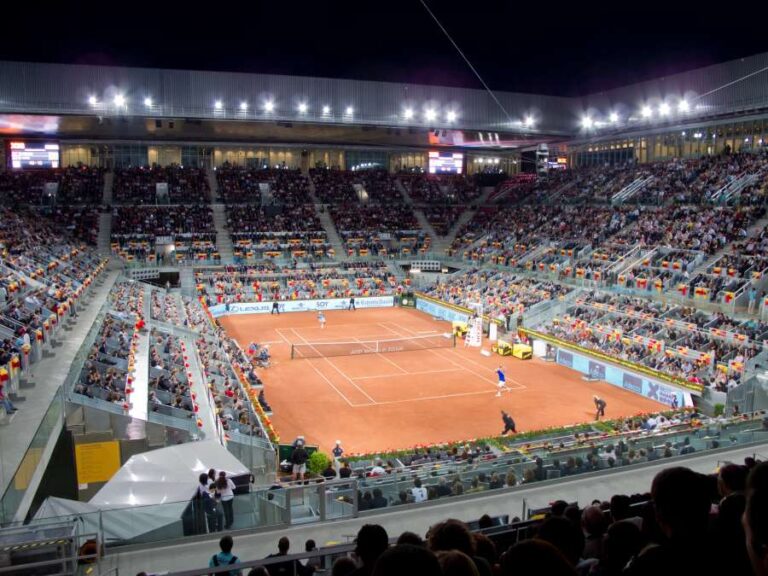
Held at the Caja Mágica, the tournament combines cutting-edge facilities with challenging playing conditions, offering a spectacle that differs significantly from traditional clay events like Monte Carlo or Rome.
Altitude and conditions: why Madrid plays differently
What truly sets Madrid apart is its altitude. Located over 600 meters above sea level, the thinner air allows the ball to travel faster and bounce higher compared to other clay tournaments.
This creates a hybrid dynamic:
- rallies are shorter than typical clay exchanges;
- aggressive players are rewarded;
- big servers gain a noticeable advantage.
As a result, Madrid often favors players who can combine clay-court movement with attacking intent, making it one of the most unpredictable Masters 1000 events of the season.
Tournament format and ranking significance
Like all ATP Masters 1000 events, Madrid features a 96-player singles draw, with seeded players receiving a first-round bye. Matches are played in a best-of-three sets format.
The tournament awards 1000 ranking points to the winner, making it a critical stop in both the ATP Rankings and the Race to the ATP Finals. Strong performances in Madrid can significantly impact seeding positions heading into Roland Garros.
As Masters 1000 Madrid guarantees the following ranking points:
- Winner: 1,000 points;
- Runner-up: 650 points;
- Semi-finals: 400 points;
- Quarter-finals: 200 points;
- Round of 16: 100 points;
- Round of 32: 50 points;
- Round of 64: 30 points;
- Round of 128: 10 points;
- Qualifiers: 20 points.
Records, champions and notable statistics
Over the years, the Madrid Open has crowned a wide range of champions, reflecting its unpredictable nature.
- Rafael Nadal (5 titles): among the most successful players, adapting his clay dominance to Madrid’s faster conditions;
- Novak Djokovic (3 titles): multiple titles, showcasing versatility across surfaces;
- Roger Federer (3 titles): success both on indoor hard and clay versions of the event.
Notably, Madrid has often produced winners outside the traditional clay-court specialists, underlining how its conditions can disrupt established hierarchies.
The tournament is also known for high tie-break frequency and shorter rallies compared to other clay Masters events, further emphasizing its unique playing style.
A key step toward Roland Garros
Positioned between Monte Carlo and Rome, Madrid plays a strategic role in the clay season.
For some players, it represents an opportunity to build momentum. For others, it serves as a testing ground to refine tactics and physical condition before the demands of Roland Garros.
Because of its faster conditions, success in Madrid does not always translate directly to Paris — but strong performances often signal a player in form.
What defines success in Madrid
Winning in Madrid requires a specific combination of skills:
- aggressive baseline play;
- effective serving under faster conditions;
- ability to adapt to high bounce;
- physical resilience across matches.
Players who can strike this balance are typically those who go deep in the tournament, regardless of their traditional surface preference.
Conclusion
The Madrid Open stands out as one of the most intriguing events on the ATP calendar. Its blend of clay-court tradition and fast-playing conditions creates a tournament where adaptability is essential and outcomes are rarely predictable.
As the clay season progresses, Madrid remains a pivotal checkpoint; one that reveals form, exposes weaknesses, and sets the stage for the final push toward Roland Garros.